Artificial intelligence was everywhere at IDUG North America 2026. Yet the conversations in Atlanta also demonstrated that the future of Db2 will not be defined by AI alone. Performance, resilience, security, modernization and knowledge sharing remain at the heart of an ecosystem learning how to innovate without losing sight of its foundations.
For four days, from October 26 to 29, IDUG North America 2026, co-located with IBM TechXchange, brought together Db2 professionals, developers, architects, technology leaders, IBM specialists, vendors and partners from around the world.
The breadth of the program reflected the richness of this community. Sessions addressed Db2 for z/OS and Db2 LUW, SQL performance, artificial intelligence, security, cloud architectures, automation, application development and the evolution of the DBA profession.
For Infotel Software, IDUG is always much more than a technical conference. It is an opportunity to step back from daily projects, listen to different perspectives and understand how organizations are preparing their critical data environments for the future.
After several days of sessions, discussions and encounters in Atlanta, one message stood out: the Db2 ecosystem is evolving, but it is doing so by building on its experience rather than turning away from it.
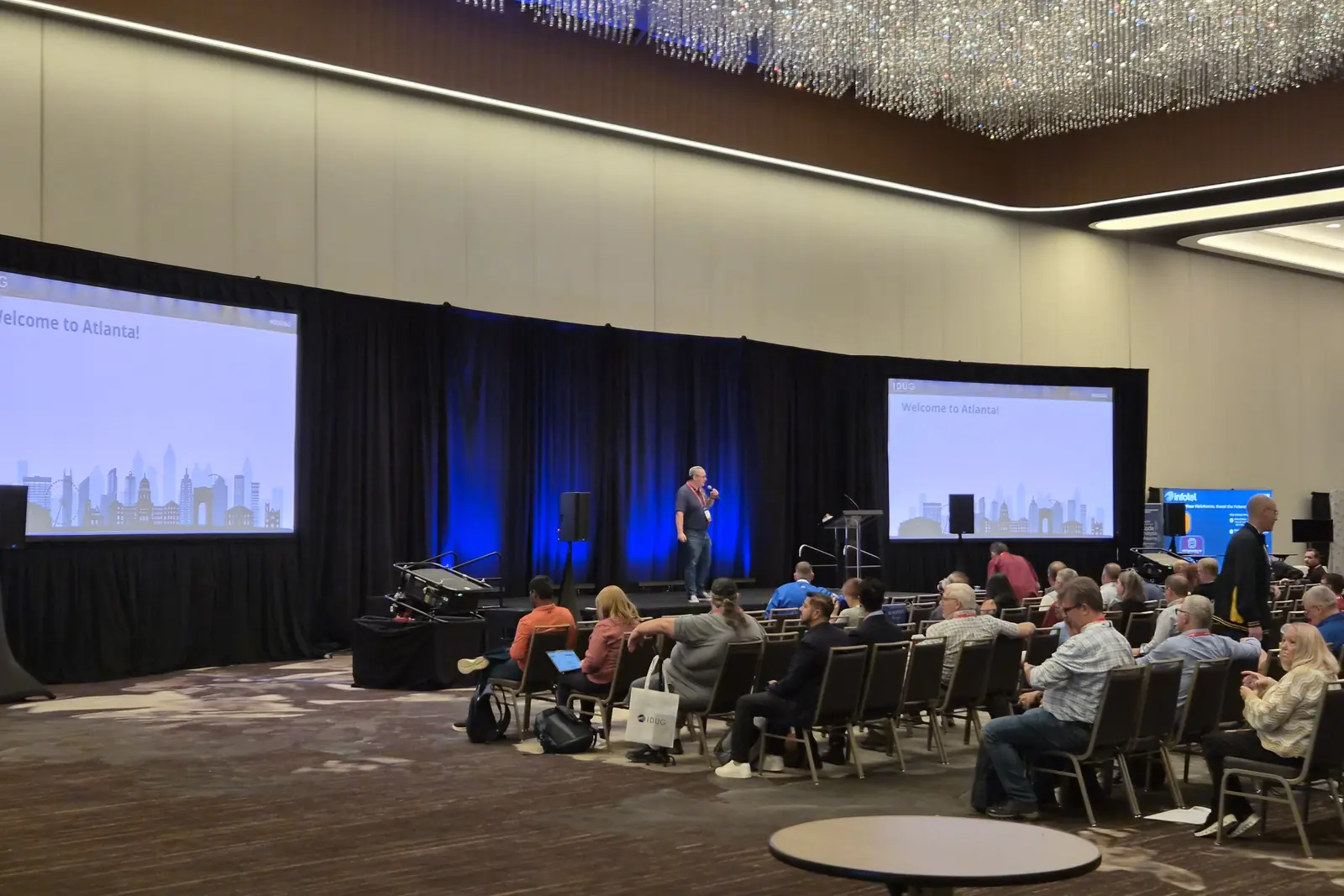
AI has moved from promise to practical discussion
Unsurprisingly, artificial intelligence was one of the dominant themes of IDUG North America 2026.
The program covered generative AI, agentic AI, vector indexes, autonomous operations, natural-language queries and the use of Db2 as a foundation for AI workloads. Sessions explored both Db2 for z/OS and Db2 LUW, showing that AI is no longer being discussed as a separate layer disconnected from operational data.
The question has changed. It is no longer simply: What could AI do for Db2?
The community is now asking more practical questions:
- How can AI support database administration?
- Can it help detect and explain performance issues?
- How can organizations connect AI models with critical enterprise data?
- Which operational decisions can be automated?
- How can recommendations remain explainable, secure and trustworthy?
The distinction between automation and autonomy was particularly significant. Traditional automation executes predefined tasks. Agentic systems aim to interpret a situation, select an action and adapt to the result.
This evolution creates opportunities, but it also raises questions about governance and accountability. In critical environments, an action must not only be fast. It must be understandable, controlled and reversible.
IDUG demonstrated that the Db2 community is ready to explore these possibilities, while maintaining the pragmatism required for systems that support essential business operations.
Modernization is no longer a single destination
Modernization was another central theme, but the program showed just how many different forms it can take.
Some sessions focused on the modernization strategy for Db2 for z/OS. Others examined containerized deployments, Amazon RDS for Db2, cloud integration, Visual Studio Code, APIs, OpenTelemetry and real-time mainframe data streaming with Kafka and Debezium. Config-as-Code was also presented as a way to make subsystem configuration more repeatable and easier to govern.
Together, these topics suggest that modernization is becoming less ideological and more pragmatic.
For some organizations, modernization means connecting mainframe data to analytics and AI platforms. For others, it means allowing developers to use familiar interfaces. It may involve introducing observability standards, automating infrastructure configuration or making data available through APIs and event-streaming technologies.
There is no universal modernization roadmap because organizations do not start from the same point. Their applications, skills, regulatory obligations and appetite for change differ.
What they share is the need to move forward without compromising the reliability of the systems on which their businesses depend.
Modernization is therefore becoming a continuous process. It is less about choosing between the mainframe and newer platforms, and more about making them work together effectively.
The fundamentals have not disappeared
While AI and modernization attracted considerable attention, the conference program devoted just as much space to the traditional foundations of database management.
SQL performance, index strategy, buffer pools, utilities, backup and recovery, HADR, high-performance DBATs, security, encryption, auditing, ransomware resilience and no-outage upgrades featured prominently throughout the event.
This balance is important.
The arrival of new technology does not remove the need for reliable, secure and efficient database operations. In many cases, it makes those requirements even more critical.
AI workloads require trusted and well-managed data. Modern applications still depend on predictable response times. Cloud integration does not eliminate the need for recovery planning. Greater connectivity creates new security and observability requirements.
Innovation and operational excellence cannot be treated as separate objectives. One enables the other.
The organizations most capable of adopting new technologies will often be those that already possess a clear understanding of their data, workloads and dependencies.
Performance remains a shared language
Performance was present throughout the four-day program, from SQL coding practices and Dynamic SQL to zIIP usage, access paths, indexing, diagnostics and cloud cost optimization.
This reflects a simple reality: performance remains one of the areas where technical and business priorities meet most directly.
A poorly performing query can affect the customer experience, delay processing, consume unnecessary infrastructure and increase operating costs. Conversely, a targeted improvement can deliver benefits across several dimensions at once.
The conference also highlighted that performance management is becoming more anticipatory. The goal is no longer only to diagnose problems after they occur, but to detect patterns, understand resource consumption and integrate quality controls earlier in the lifecycle.
This requires both tools and expertise. Metrics can indicate that something has changed, but experienced professionals are still needed to understand why it has changed, determine whether it matters and select the appropriate response.
The role of the DBA is changing, not disappearing
Several sessions addressed the changing role of database professionals, including one whose title asked directly whether this could be “the end of DBAs for Db2 for z/OS.” Other presentations explored smarter administration, basic automation and AI-enabled database operations.
The combined message was not that database expertise is becoming obsolete.
Instead, the role is expanding.
As routine activities become more automated, DBAs are increasingly expected to understand application development, cloud services, security, observability, data governance and automation frameworks. They are moving from executing individual technical tasks toward designing the standards and processes through which those tasks are performed.
AI may accelerate this evolution by helping professionals analyze complex environments or identify possible actions. But recommendations still need to be validated against business context, operational risk and technical reality.
The DBA of the future may spend less time performing repetitive operations. That does not make the role less important. It makes judgment, communication and cross-platform understanding even more valuable.
Preparing the next generation
The future of the profession was present from the opening day, with a session dedicated to frameworks for developing the next generation of Db2 professionals.
This is one of the main strategic challenges facing the ecosystem.
Db2 and the mainframe benefit from decades of accumulated expertise. Many experienced professionals possess knowledge that cannot easily be captured in documentation alone. At the same time, new engineers often arrive with experience in cloud platforms, APIs, containers, open-source technologies, DevOps and AI-assisted development.
The objective should not be to ask one generation to adopt the other’s perspective. It should be to bring both together.
New interfaces and development environments can lower the barrier to entry. Mentoring and technical communities can preserve knowledge. Conferences such as IDUG create an environment in which professionals at different stages of their careers can learn from one another.
This transfer of expertise is essential. Technology can be modernized through software, but an ecosystem is sustained through people.
Experience remains one of the community’s greatest assets
Some of the most compelling sessions in the program were explicitly grounded in experience: forty years working with Db2, lessons learned from high-performance environments, stories from production and customer accounts of real-world implementations.
This practical dimension is one of IDUG’s defining characteristics.
The conference does not only present what technology is designed to do. It creates space to discuss what happens when that technology meets complex applications, operational pressures and organizational constraints.
For the Infotel Software team, conversations with customers, partners, IBM teams and recognized experts including Craig S. Mullins and Sheryl M. Larsen were among the highlights of the week.
These discussions connect the formal program with the realities encountered by organizations every day. They also remind us that technical progress is rarely linear. It is built through experimentation, lessons learned and the willingness to share both successes and difficulties.
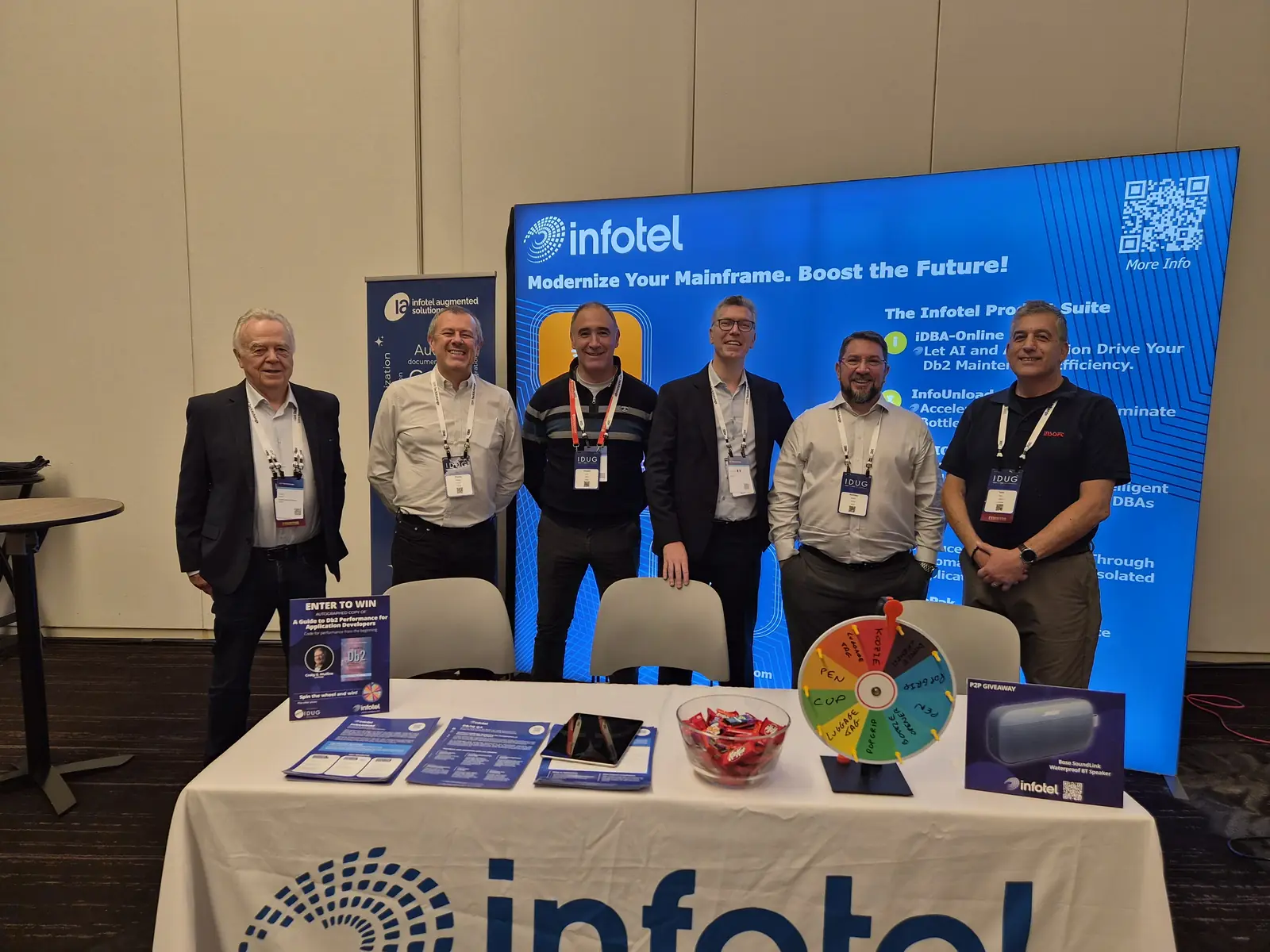
Contributing to the conversation
Infotel Software was also proud to contribute directly to the technical program.
Colin Oakhill presented “Stabilize your Dynamic SQL and don’t let it remain Unpredictable,” examining how organizations can gain greater stability and control over Dynamic SQL behavior.
Vincent Arrat also led a workshop on “Optim High Performance Unload for Db2 for LUW: Accelerating Data Access and Modern Workloads.”
These contributions formed part of a much wider exchange involving IBM specialists, independent experts, users and technology providers.
That diversity of voices is essential. The challenges facing Db2 organizations cannot be understood from one perspective alone. They require input from the professionals developing the technology, those operating it and those depending on it for critical business activities.
Building the next chapter
IDUG North America 2026 showed a community that is not standing still.
AI is moving closer to operational reality. Automation is reshaping database administration. Modern development tools are making mainframe environments more accessible. Cloud and distributed technologies are creating new ways to connect data and applications.
Yet the conference also confirmed that the fundamentals remain unchanged.
Performance matters. Security matters. Resilience matters. Most importantly, expertise matters.
The next chapter of Db2 will not be written by choosing innovation over experience. It will be written by combining them.
Thank you, Atlanta
We returned from Atlanta with new perspectives, valuable conversations and many ideas to explore.
We would like to thank the IDUG organizers, speakers, volunteers and community members who made the event possible. We also thank everyone who attended the Infotel Software sessions, visited our team or took the time to share their experience.
IDUG North America 2026 reminded us that even as technologies evolve, progress remains fundamentally collective.
Thank you, Atlanta. We look forward to continuing the conversation and meeting the Db2 community again at the next IDUG.
Meet us at upcoming events
See the events Infotel Software takes part in, or contact our team to talk about your Db2 environments.